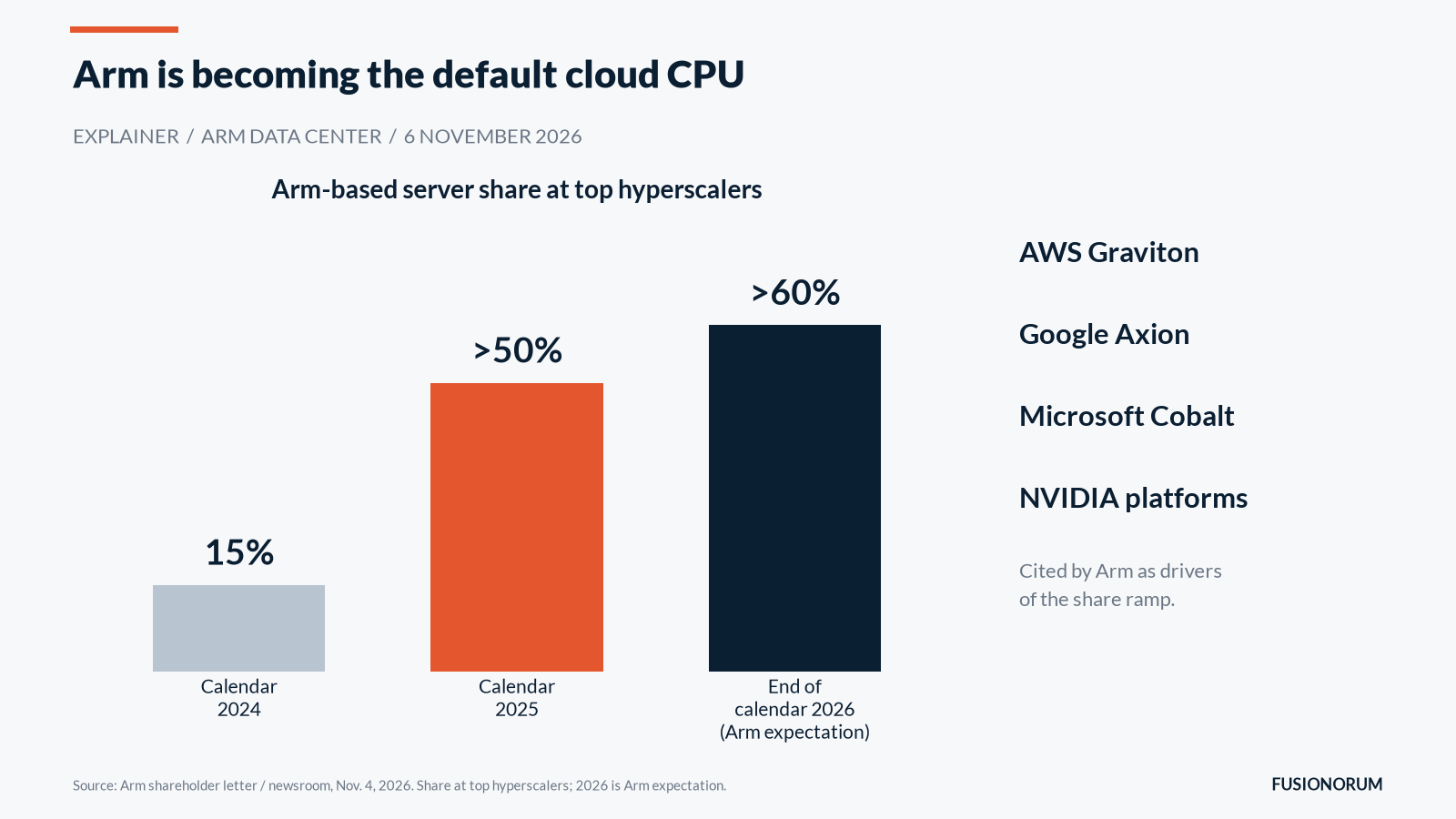
Arm data center economics are shifting fast: the company said Arm-based servers already account for more than half of deployments at top hyperscalers, and it expects that share to exceed 60% by the end of calendar 2026 as AI rebuilds the server CPU stack. The claim sits inside Arm’s Nov. 4 shareholder letter for the second quarter of fiscal 2027, which ended Sept. 30. Total revenue rose 27% year over year to a record second-quarter $1.44 billion—the fifth consecutive quarter of more than 20% growth. Licensing and other revenue jumped 50% to $773 million. Royalty revenue rose 8% to $670 million, and data-center royalties doubled. Partners shipped more than 10 billion Arm-based chips in the quarter, up 1.5 billion from a year earlier, on a platform used by more than 30 million developers. Why it matters: cloud operators are rewriting the x86-centered server mix. Custom Arm CPUs—AWS Graviton, Google Axion, Microsoft Cobalt and NVIDIA platforms—are winning general-purpose racks and the host processors beside AI accelerators. Arm is also leaving its pure-IP comfort zone with the Arm AGI CPU silicon product. That combination changes how investors should read licensing spikes, royalty lags and multi-year purchase orders. How does Arm make money from data center chips? Arm’s core model remains licensing plus royalties. Customers pay for access to Arm architectures, cores and related IP. When partners ship chips that use Arm technology, Arm collects a royalty on each unit. Licensing is a leading indicator. The 50% jump to $773 million signals partners are committing to designs that should produce royalties later. Royalties of $670 million still reflect chips already shipping. Reuters reported that licensing beat estimates of about $625 million while royalties missed estimates of about $721 million. Total revenue of $1.44 billion still beat the roughly $1.38 billion consensus, and non-GAAP earnings were $0.52 a share against estimates of about $0.47. Data-center royalties doubled year over year even as the overall royalty pool grew only 8%. Cloud and AI-related silicon is therefore growing much faster than the rest of the Arm installed base inside the same royalty total. Q2 FYE27 licensing and other revenue $773M (+50% y/y) versus royalty revenue $670M (+8% y/y). Why is Arm data center share rising so quickly? Arm said Arm-based server market share at top hyperscalers rose from 15% in calendar 2024 to more than 50% in calendar 2025, and it expects the figure to exceed 60% by the end of calendar 2026. It cites AWS Graviton, Google Axion, Microsoft Cobalt and NVIDIA platforms. Amazon, Arm said, recently reported that Arm-based Graviton revenue commitments increased more than 20 times year over year. Google has called Axion a critical component of its AI infrastructure. Microsoft has highlighted Cobalt adoption. NVIDIA continues to expand Arm-based Vera CPU platforms for agentic AI workloads. The technical pitch is efficiency. Arm designs have long been prized for performance per watt—an attribute that matters as AI clusters raise power and cooling costs. Arm also said Arm-based PCs have reached about 20% of global PC shipments. The share figures are Arm’s characterization of top-hyperscaler deployments, not an audited industry census, but the direction aligns with cloud providers’ own Arm CPU families—and with related demand that has lifted other suppliers, including AMD’s recent data-center sales surge. What is the Arm AGI CPU silicon business? Alongside its IP franchise, Arm is building a silicon business around the Arm AGI CPU—chips it designs and sells more directly. Confidence has increased in achieving up to $2 billion of Arm AGI CPU revenue over FYE27 and FYE28, Arm said, supported by additional supply and customer mix. Purchase orders extend through calendar 2027. First commercial deliveries remain on track for the fourth quarter of FYE27. Oracle Cloud Infrastructure plans to offer Arm AGI CPU instances in 2027. Independent testing by Signal65, cited by Arm, showed the Arm AGI CPU delivering roughly twice the performance per rack versus AMD’s EPYC 9755. That is a vendor-attributed benchmark, not a universal ranking. Licensing scales with little incremental cost of goods; selling finished CPUs brings supply-chain exposure—foundry, packaging, memory and inventory—while capturing more of the value chain. Record $1.44B Q2 revenue (+27% y/y) alongside Arm’s up-to-$2B AGI CPU ambition over FYE27–FYE28. What does this mean for markets and competitors? AI is accelerating both of Arm’s engines: partners paying for more IP, and customers placing multi-year silicon orders. Reuters reported third-quarter revenue guidance of about $1.54 billion, slightly above the then-consensus of about $1.53 billion. For Intel and AMD, the hyperscaler share shift is a structural challenge in standard server CPUs, even as both pursue AI accelerators. For cloud buyers, a broader Arm option set can improve bargaining power and energy economics. For the wider semiconductor chain, more Arm servers still consume advanced process capacity, high-bandwidth memory and packaging. Watch items: whether licensing strength converts into faster royalty growth; whether AGI CPU deliveries begin in Q4 FYE27 without supply slippage; and whether hyperscaler share gains continue once the easy substitution wave matures. Arm’s November letter does not prove dominance of every server socket. It does show that the Arm data center franchise is no longer a niche experiment. Share at the largest cloud operators has already more than tripled in Arm’s telling, data-center royalties have doubled, and a new silicon product aims to monetize the same architecture more directly. The next proof points are shipped AGI CPUs and whether royalty growth catches the licensing lead. Quick facts Q2 FYE27 revenue: $1.44 billion, up 27% year over year; highest-ever second quarter Licensing and other: $773 million, up 50%; royalties: $670 million, up 8%; data-center royalties doubled Non-GAAP EPS: $0.52 vs Street ~$0.47; total revenue beat ~$1.38 billion estimate (Reuters) Hyperscaler Arm server share: 15% (2024) → >50% (2025); Arm expects >60% by end-2026 Arm AGI CPU: up to $2 billion revenue ambition over FYE27–FYE28; first deliveries targeted for Q4 FYE27; OCI instances planned for 2027 Q3 revenue guide: about $1.54 billion (Reuters) Sources: Arm shareholder letter and company statements, with Reuters reporting.