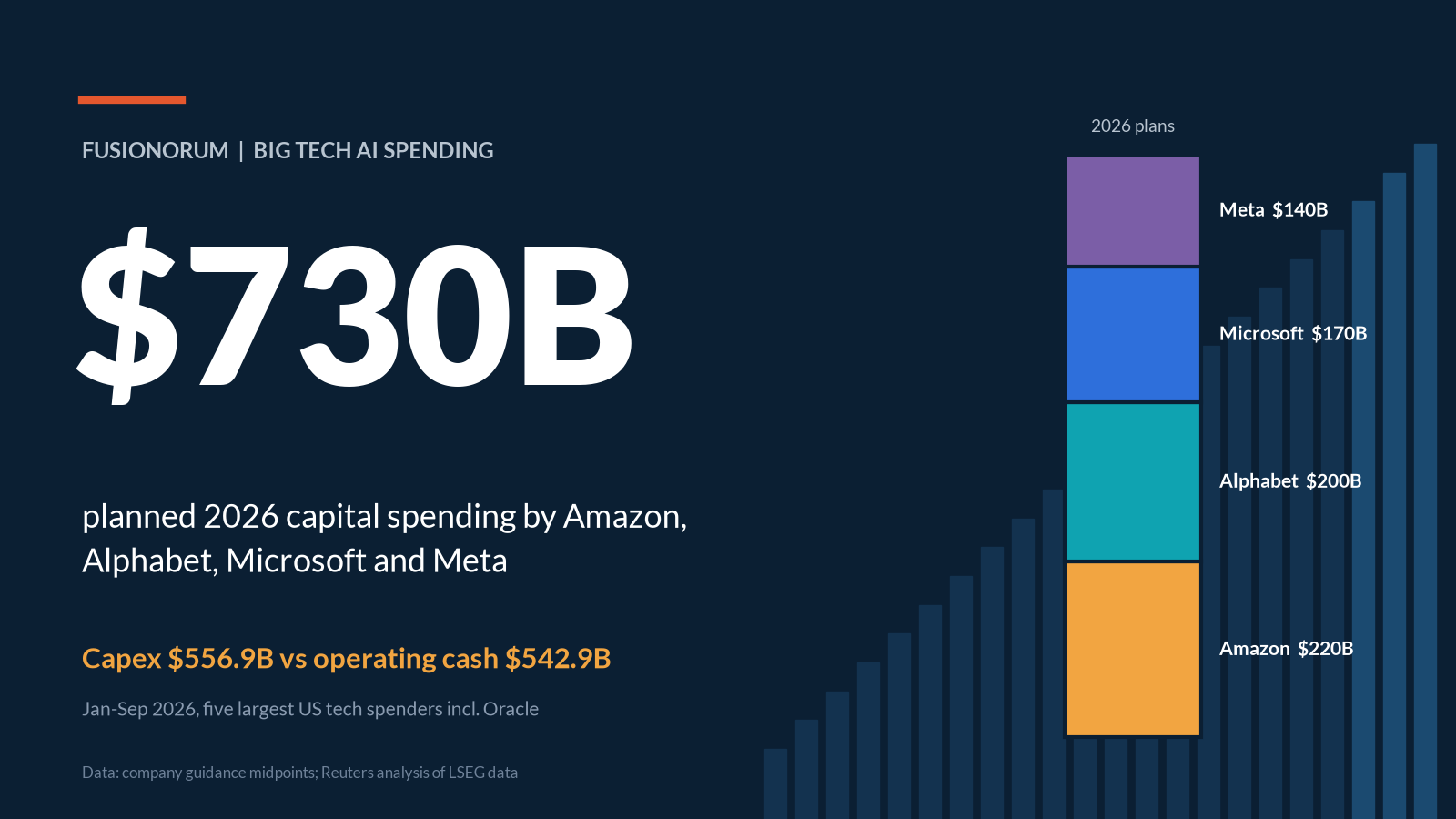
Big Tech AI spending has crossed a line that held for at least 15 years: the largest US technology companies are now investing more in data centers and chips than their businesses generate in cash. Microsoft, Alphabet, Amazon, Meta and Oracle spent $556.9 billion on capital projects in the first nine months of 2026, against operating cash flow of $542.9 billion, according to a Reuters analysis of LSEG data. It was the first time capital spending exceeded the cash the five firms generated in data going back to 2011. The shift matters because it changes what investors own. For a decade, the group funded growth and still returned large sums through share buybacks. Now the gap is being closed with bonds, share sales and leases, and the market has started to sort the companies by how well their cash flow covers the bill. Why is Big Tech AI spending outrunning cash flow? The short answer is scale. Amazon, Alphabet, Microsoft and Meta spent a combined $208.7 billion on capital expenditure in the July to September quarter, based on their third-quarter reports. Amazon alone reported $77.3 billion of purchases of property and equipment, Alphabet $51.4 billion, Microsoft $45.2 billion including finance leases and Meta $34.9 billion including finance-lease principal. Cash generation is growing, just not as fast. Reuters found that operating cash flow at the five companies rose 29% to a record in the first nine months, while capital spending doubled. The result was a combined free cash flow deficit of $14 billion, compared with a surplus of $143.5 billion a year earlier. The plans point higher still. The four hyperscalers spent about $413.4 billion in 2025, and the midpoints of their current 2026 guidance add up to roughly $730 billion after Microsoft trimmed its calendar-year outlook to about $170 billion from $175 billion, CNBC reported. Amazon expects about $220 billion, Alphabet $195 billion to $205 billion and Meta $135 billion to $145 billion. Which companies can still fund AI from their own cash? Only one of the four did so last quarter. Microsoft generated $58.0 billion of operating cash flow and paid $39.4 billion for property and equipment, leaving free cash flow of $18.6 billion, nearly $10 billion more than analysts expected, according to Reuters. Alphabet, by contrast, put 121.4% of its operating cash flow into capital spending, against 68% at Microsoft excluding finance leases. Alphabet reported negative free cash flow of $9.07 billion, its second negative quarter in a row, and its shares fell more than 12% on October 29, their worst day on record, erasing roughly $500 billion of market value. Tabbicus covered that report in Alphabet earnings disappoint as free cash flow turns negative. Meta posted negative free cash flow of about $2.1 billion, and Amazon's free cash flow over the 12 months to September 30 was an outflow of $42.4 billion. How are Alphabet, Amazon and Meta paying for the gap? Mostly with outside capital, and by cutting buybacks. The five companies reduced share repurchases by 83% to $13.6 billion in the first nine months of 2026, from $81.8 billion a year earlier, Reuters reported. Alphabet and Meta have not bought back a share this year. Dividends, which investors treat as a firmer commitment, rose to $37 billion from $33.9 billion. In total the group returned 9.3% of the cash it generated to shareholders, down from 27.4%. Borrowing has filled much of the rest. Amazon raised $48.1 billion of long-term debt in the third quarter. Alphabet raised about $29 billion from debt and $12.4 billion from share sales, part of more than $140 billion through debt and equity offerings this year, according to Reuters. Meta has raised $62.5 billion and Amazon $98 billion through bond deals in 2026. Microsoft was reported to be seeking about $25 billion in its first US investment-grade bond sale in more than nine years. "The current regime may increasingly be characterized by greater equity and debt issuance, a request of capital from investors," Ehren Stanhope, co-head of investment management at Franklin Templeton, told Reuters. Is cloud revenue growing fast enough to justify the spending? Demand is still accelerating. Amazon Web Services grew 39% to $46.0 billion in the third quarter, Microsoft's Azure grew 48% to $33.2 billion and Google Cloud more than doubled to $30.71 billion, up 103%. Amazon reported an AWS backlog of $578 billion, and Microsoft's commercial remaining performance obligations stood at about $677 billion. The comparison with spending is less flattering. Amazon's quarterly capex rose about 120% from a year earlier and Alphabet's about 114%, well ahead of their cloud growth rates. Microsoft's backlog was also flat on the quarter. Supply is part of the story: Microsoft Chief Financial Officer Amy Hood said delays at third-party GPU providers would push some capacity into the first half of 2027, CNBC reported, and Alphabet said outside computing power came online only at the very end of the quarter. What happens to Big Tech AI spending in 2027? None of the four has given a dollar figure for next year, but all have pointed up. Amazon Chief Executive Andy Jassy said 2027 spending will be "meaningfully more" than this year. Alphabet said capex will "increase significantly." Microsoft's Hood said spending would accelerate in the first half of 2027 as delayed deliveries and higher component costs land. Analysts' consensus for the four stands near $934.5 billion, about 28% above 2026, according to estimates compiled by Yield Theory, and CNBC noted that group spending is expected to top $1 trillion next year by some measures. The next test arrives with fourth-quarter results and 2027 guidance early next year. Investors will watch three numbers: how quickly backlogs turn into revenue, how much new depreciation weighs on earnings now that buybacks no longer lift per-share profit, and what the debt funding the build-out costs as interest rates rise. Until cloud growth closes the gap, Big Tech is asking shareholders to accept less cash today for a larger bet on AI returns tomorrow. Quick facts Capex at Microsoft, Alphabet, Amazon, Meta and Oracle, Jan to Sep 2026: $556.9 billion, versus $542.9 billion of operating cash flow. Combined free cash flow: minus $14 billion, from plus $143.5 billion a year earlier. Buybacks: down 83% to $13.6 billion; share of cash returned to investors 9.3%, from 27.4%. Third-quarter capex of the four hyperscalers: about $208.7 billion; 2026 plans about $730 billion. Only Microsoft posted positive quarterly free cash flow: $18.6 billion. 2027 analyst consensus for the four: about $934.5 billion. Sources: company filings and earnings calls, Reuters and CNBC reporting, and analyst estimates.