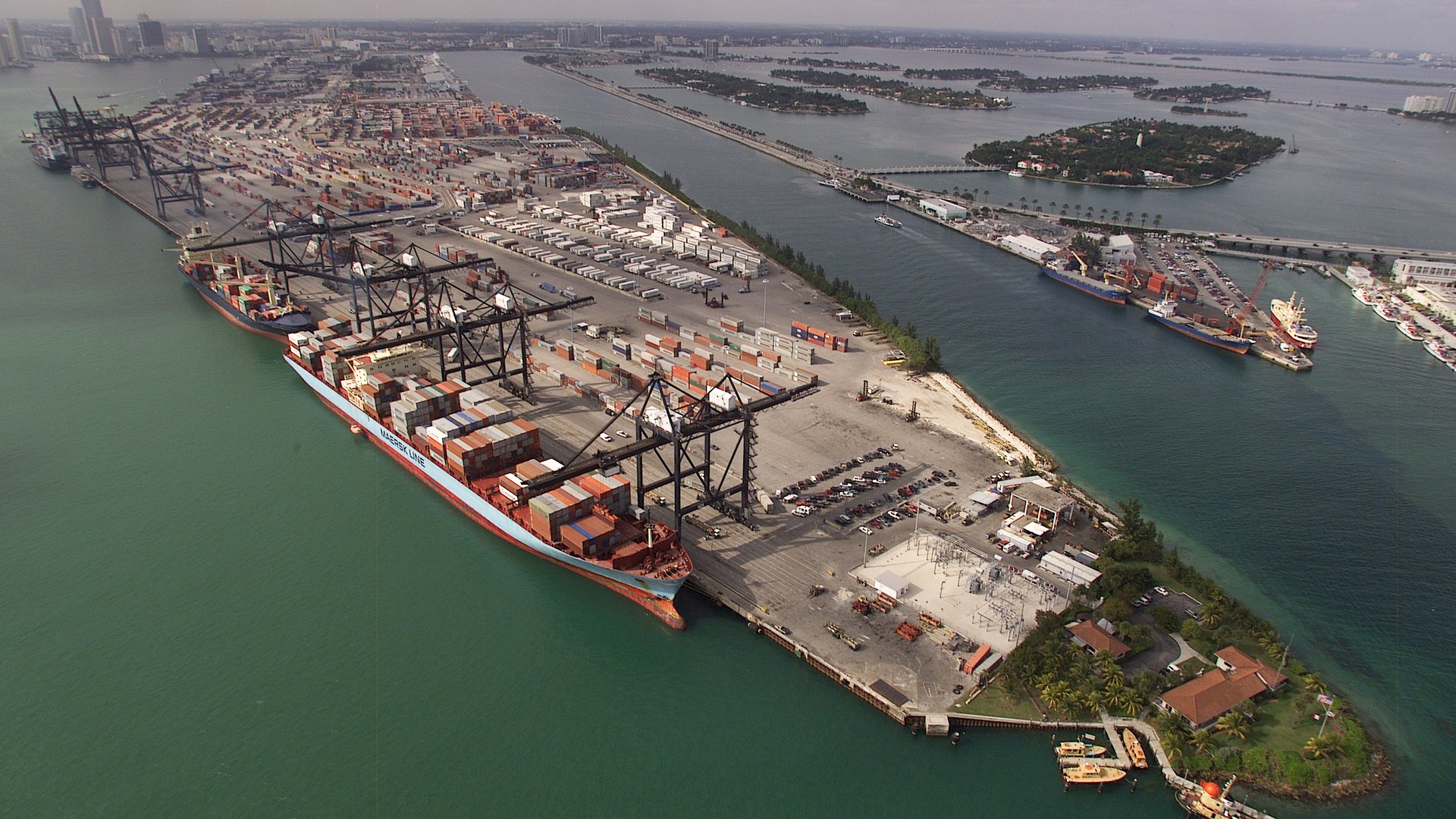
The history of supply chain management stretches back more than two thousand years, to grain fleets that fed ancient Rome and caravans that carried silk across Eurasia, yet the term itself was coined only in 1982. In between came the railway, the moving assembly line, the shipping container and the barcode, each making it cheaper to turn raw materials into goods and move them to buyers. The story matters because one trade-off runs through every era: efficiency against resilience. Each advance stripped out cost and inventory, and each major disruption, most recently in 2020 and 2021, showed how much depends on a few links holding. Global value chains, in which goods cross borders several times before reaching a buyer, now account for almost half of all trade, according to the World Bank. How did ancient supply chains work? The Silk Roads were never a single road. UNESCO describes them as a network of land and sea routes carrying silk alongside textiles, spices, grain, tools and precious stones. Most caravans covered one section and sold their cargo along the way, an early version of the relay that defines modern networks. Rome ran one of the most demanding supply operations of the ancient world. The city, whose population is estimated to have reached about one million by the second century AD, imported the grain it ate, mostly from Egypt, North Africa and Sicily. Historian Geoffrey Rickman estimated it needed about 272,000 tonnes a year. Economists David Kessler and Peter Temin calculated the trade required 2,000 to 3,000 merchant voyages annually. Shipping grain the length of the Mediterranean was cheaper than carting it about 75 miles over land, an advantage for water transport that still shapes trade. How did the Industrial Revolution change supply chains? Steam collapsed travel times. The Liverpool and Manchester Railway, opened on Sept. 15, 1830, was the world's first steam-powered intercity line built for passengers and goods, according to the Science and Industry Museum in Manchester. It linked Britain's main port for raw cotton with the mills that spun it, cutting a 12-hour canal trip to 1 hour and 46 minutes. What did Henry Ford add to the supply chain? Ford Motor Co. introduced the moving assembly line at its Highland Park plant in Michigan in 1913. The best stationary method had taken 12 hours and 28 minutes of labor per chassis, Henry Ford later wrote; by 1914 the moving line needed about 93 minutes. The price of a Model T fell from $850 to $260, according to Ford. Workers assemble flywheel magnetos on Ford's first moving line at Highland Park in 1913. Ford then pursued vertical integration. At the River Rouge complex, built between 1917 and 1928, iron ore, coal, limestone, rubber and sand went in and finished cars came out. The company owned forests, mines, ore freighters and a railroad, according to The Henry Ford museum, yet the Rouge never had fewer than 6,000 suppliers. How did the shipping container change trade? On April 26, 1956, trucking executive Malcom McLean sent the converted tanker Ideal-X from Port Newark, N.J., to Houston with 58 containers on deck. McLean calculated that loading a medium-size ship by hand cost $5.83 a ton, against less than 16 cents for containers. Standard boxes moving between ship, truck and train made distant sourcing practical. UNCTAD, the United Nations trade agency, estimates that around 80% of world goods trade by volume now travels by sea. What is just-in-time manufacturing? Toyota supplied the next idea. Kiichiro Toyoda proposed "just-in-time" production when the Koromo plant opened in 1938: parts should arrive only in the quantity needed, when needed, according to the company's official history. The concept was fully realized after 1954 with the "supermarket method," in which each process pulls only what it needs from the one before, signaled by cards called kanban. In 1988, researcher John Krafcik labeled the approach "lean production." Who coined the term supply chain management? Booz Allen Hamilton consultant Keith Oliver introduced the phrase in a Financial Times interview published June 4, 1982. Working with Dutch electronics maker Philips, Oliver argued that manufacturing, marketing, distribution, sales and finance should be run as one flow rather than rival silos, according to Booz Allen. Data tools followed. On June 26, 1974, a pack of Wrigley's gum became the first product scanned by its Universal Product Code, at a Marsh supermarket in Troy, Ohio; GS1 US says barcodes are now scanned more than 10 billion times a day. In 1990, Gartner coined "enterprise resource planning," or ERP, for software linking planning across a company. Together these tools made offshoring routine and underpin today's big retailers, as the Munitorum explainer on how Costco makes money shows. What went wrong in 2020 and 2021? The pandemic exposed how little slack lean networks carried. Demand swung, ports jammed and Drewry's World Container Index hit a record $10,377 per 40-foot container on Sept. 23, 2021. On March 23, 2021, the 20,000-TEU ship Ever Given ran aground in the Suez Canal and blocked it for six days. Lloyd's List estimated the closure held up about $9.6 billion of goods a day. The Ever Given lodged in the Suez Canal, seen from the International Space Station on March 27, 2021. What is the future of supply chain management? Companies have since tilted from cost-cutting toward supply chain resilience. In McKinsey's 2024 survey of supply chain leaders, 73% reported progress on dual sourcing and 60% said they were regionalizing their networks, a shift often called nearshoring. Artificial intelligence is next, though adoption is early: in McKinsey's 2025 survey, three-quarters of respondents were planning or piloting AI, but only 19% were deploying it at scale, mainly for demand forecasting, inventory and supply planning. The tools have moved from grain barges to algorithms, but the task would be familiar to a Roman grain merchant: get the right goods to the right place at an acceptable cost, while keeping enough slack to survive the next shock. Quick facts Keith Oliver of Booz Allen introduced "supply chain management" in a Financial Times interview on June 4, 1982. Malcom McLean's Ideal-X carried 58 containers from Newark to Houston on April 26, 1956. Ford's moving line cut chassis assembly from about 12.5 labor hours to about 93 minutes by 1914. The Ever Given blocked the Suez Canal for six days in March 2021. Sources: company histories, industry research, museum archives and academic studies.