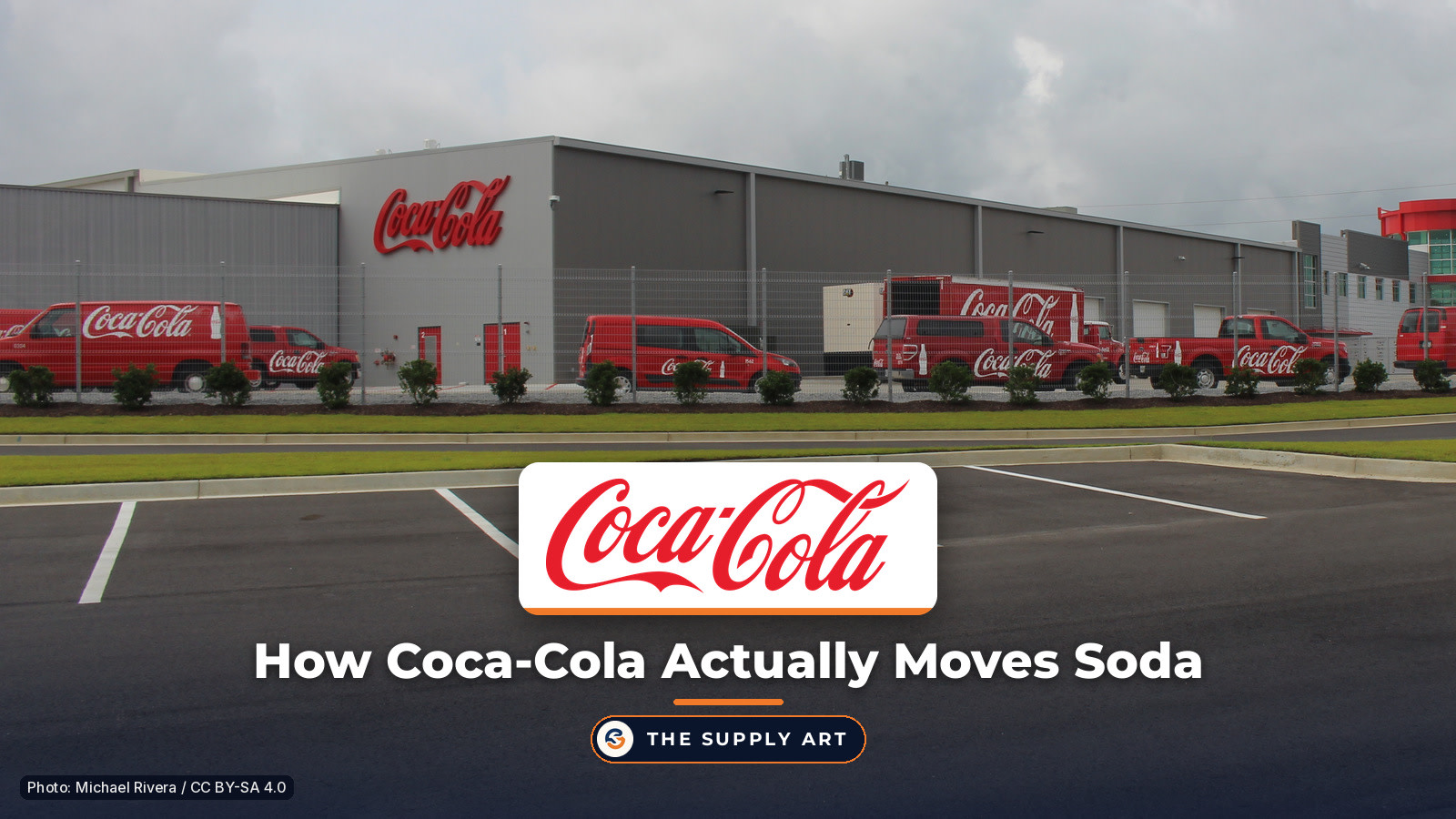
It is five in the afternoon at a corner shop in Saigon. The motorbikes are stacking up outside, the red cooler by the door is half empty, and the owner is on the phone to her distributor about tomorrow's drop. She will get her Coke. She almost always does. But notice where it comes from. Not Atlanta. Not The Coca-Cola Company at all. It comes from a bottler, in Vietnam's case Swire Coca-Cola, which bought the local bottling business from Coke at the start of 2023, with three plants and six distribution centres. That is the whole Coca-Cola supply chain in one cooler. The company behind the most famous drink on earth mostly does not make the drink, fill the bottle or drive the truck. It makes concentrate and sells it to someone who does. The mental model for this one is the decoupling point: the spot in a supply chain where you stop building to a forecast and start building to real, local demand. Most companies put it inside their own four walls. Coca-Cola put it at the edge of the company itself, between a drum of concentrate and nearly 225 independent bottlers, by its own count. Upstream: few products, few plants, one global plan. Downstream: thousands of packs, sweeteners and delivery routes, owned by somebody else. Let's tear it down. Plan: two volumes, one system Coca-Cola tracks two numbers that tell you exactly where the decoupling point sits. One is unit case volume, the drinks consumers actually buy from bottlers. The other is concentrate sales, what Coke ships to those bottlers. In the third quarter of 2026, concentrate sales ran two points ahead of unit case volume "due to the timing of concentrate shipments," and the CFO warned of "slight destocking" in the fourth quarter. That is a buffer at work. Bottlers hold some concentrate, and the gap between the two numbers is the system breathing in and out. Concentrate is compact and stable next to the finished drink, so a little inventory here absorbs a lot of noise downstream. The planning is joint. On the October 2026 earnings call, CEO Henrique Braun, who took over from James Quincey at the end of March, described working through 2027 plans with bottlers and a Cross Enterprise Procurement Group that buys the system's big commodities together. Many companies on paper, one buying brain in practice. Source: the syrup is easy, the can is not Coke's own sourcing list is short: the flavourings and ingredients that go into concentrates. The heavy stuff belongs to the bottlers. Per the 2025 10-K, water is a main ingredient in substantially all products, the principal sweetener in the US is high fructose corn syrup, and outside the US it is ordinary sucrose. Among PET, glass, closures and CO2, the filing flags that aluminium cans "are available from a limited number of suppliers." That last line has been doing a lot of work. The US raised its Section 232 tariff on aluminium to 25% in March 2025 and to 50% that June. Back in February 2025, Quincey said that if cans got pricier, the system could "put more emphasis on PET bottles." Packaging flexibility as a hedge. Nice in theory. In practice, Coca-Cola Consolidated, the largest US bottler, said in November 2026 that aluminium and fuel costs had outpaced its price increases, pulling its third-quarter gross margin down 80 basis points to 38.8%. Then there is cane sugar. After President Trump's public push in July 2025, Coke launched Coca-Cola made with US cane sugar that autumn, in 12-ounce glass bottles in select markets. The rollout was slow for a supply chain reason, not a marketing one: limited cane sugar supply and limited glass bottling capacity. Coca-Cola Consolidated is now adding a glass line in Indianapolis. A new recipe is a press release. A new package is a capex cycle. Make: a few concentrate plants, hundreds of bottling plants This is the asset split in its purest form. Concentrate is made in a small number of company plants, behind the most famous trade secret in business. Bottling happens in hundreds of local plants owned by partners: Coca-Cola FEMSA across Mexico and much of Latin America, Coca-Cola Europacific Partners from Germany to the Philippines, Coca-Cola HBC from Italy to Nigeria, Arca Continental, Swire. Per the 10-K, those five alone made up 44% of worldwide unit case volume in 2025. The split shows up in the money. Coke's comparable operating margin was 32.9% in the third quarter of 2026. Coca-Cola Consolidated's operating margin, selling the same brand, was 13.7%. Same can, very different business. Move: the bottler owns the last mile Moving heavy, low-value liquid to millions of outlets is the hard, expensive part, and it belongs to the bottlers. In the US that is largely direct store delivery: bottler trucks, merchandisers and warehouses, like the distribution centre on our cover in Tifton, Georgia, lined with red vans. In Vietnam it is distributors feeding a vast web of corner shops. Coke designs the brand and the playbook. The bottler eats the diesel. Sell: refranchising, again and again For a decade Coke has pushed its decoupling point further out by selling bottlers it once bought back. Bottling investments fell from 52% of revenue in 2015 to 13% in 2024, the company said. In 2024 it sold the Philippines to CCEP and a local partner. In 2025 it sold a 40% stake in Hindustan Coca-Cola Beverages to the Jubilant Bhartia Group, sold its stake in Coca-Cola Consolidated, and agreed to sell 75% of Coca-Cola Beverages Africa to Coca-Cola HBC, with closing targeted by the end of 2026. After that, Coke expects bottling to be about 5% of revenue, and it is exploring an IPO of its Indian bottler. The big trade-off: margin and focus versus control The franchise model gives Coke a high-margin, low-capital business and lets every bottler act local. The price is control over the expensive, messy, physical part of the chain. On the Q3 2026 call, an analyst put it plainly: the inflationary pressures facing the system "sit more heavily with your bottling partners" than with concentrate. If bottler economics crack, so does the system, so Coke has to keep partners healthy, not just squeeze them. The weak link: the bits Coke still makes itself Here is the irony. The places where Coke has stumbled lately are the finished-goods businesses it runs directly. North American volume was flat in Q3 2026, partly due to "temporary challenges in certain finished goods businesses," and Braun named BODYARMOR and "our supply chain" as work for next year. Fairlife spent early 2026 with supply lagging demand while its new Webster, New York plant ramped up. The asset-light giant is least sure-footed exactly where it is asset-heavy. What operators can steal Put your decoupling point at your simplest product. Coke plans globally at the concentrate stage, where items are few and stable, and lets complexity explode only after that. Make packaging a lever, not a given. Being able to shift volume between cans, PET and glass is a real hedge against tariffs, but only if the lines, moulds and suppliers exist before you need them. Watch the gap between your shipments and your customers' sales. Coke reports concentrate shipments against consumer volume every quarter. If you cannot see your channel inventory, you cannot see your bullwhip coming. Amateurs discuss tactics, professionals discuss supply chain, and Coke worked out a century ago that the secret formula is the easy part to move. So, over to you: where is your decoupling point, and did you choose it or did it just happen?