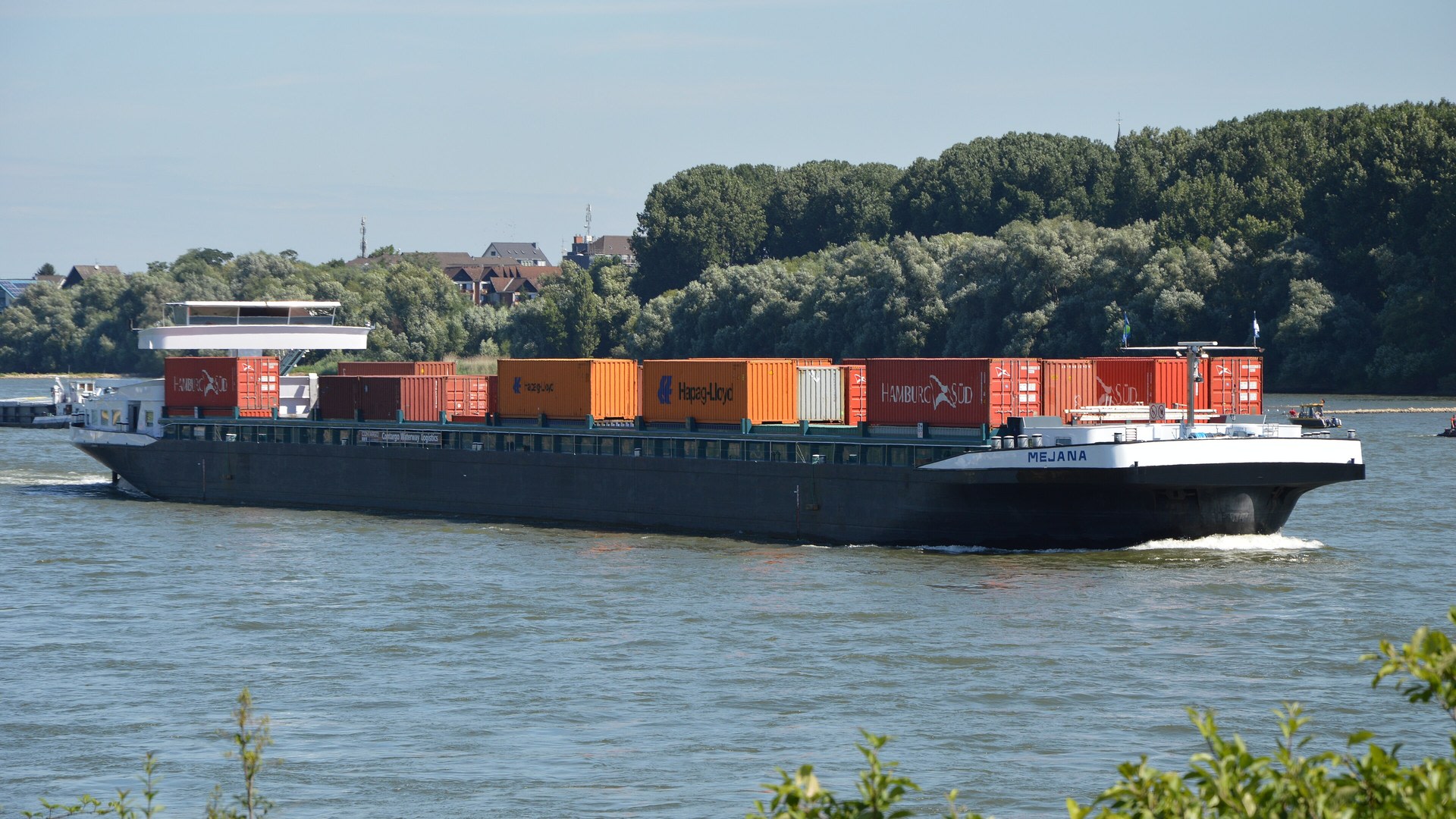
The Rhine low water that has crippled barge traffic on Europe's busiest inland waterway since summer is starting to ease. Rain lifted the gauge at Kaub, the river's key chokepoint, to 49 centimeters on Thursday evening from 11 cm earlier in the week, and Germany's Federal Institute of Hydrology, or BfG, said an end to the extreme conditions is in sight. The institute's weekly low-water report on Nov. 12 forecast rises of several decimeters, and more than a meter on the Middle Rhine, in the coming days. Its forecast for Kaub showed the gauge near 79 cm by Saturday morning, just above the 77 cm reference level for a navigable channel. The stakes are large for the chemical, steel and energy companies along the river. For months, barges have sailed part-loaded, surcharges have topped 1,000 euros a container and shippers have scrambled for trains and trucks. Why are Rhine water levels so low this year? The drought began with a dry winter and thin Alpine snowpack. Provisional federal gauge data show Kaub fell to a daily average of minus 5 cm on Oct. 1, about 30 cm below the previous record of 25 cm set in October 2018. A negative reading reflects the gauge's fixed reference point, not a dry river. The BfG blames depleted groundwater. Base flow at Kaub, the slow release from underground storage, was about 342 cubic meters a second on Nov. 11, out of a total of 510. On the same date in 2018 it was about 40% higher, which is why the river has dropped back quickly after earlier rains. Rock shoals exposed in the Middle Rhine near Oberwesel. How does the Kaub water level affect shipping costs? Barges bound for Mainz, Mannheim, Strasbourg and Basel must pass Kaub. At low levels they load less to clear the riverbed, so more trips are needed for the same tonnage, and the cost is passed on as a low-water surcharge. Hapag-Lloyd's Rhine surcharge, revised from Nov. 1, charges 300 euros for a 20-foot container when Kaub reads 71 to 80 cm, 1,075 euros at 31 to 40 cm and 1,350 euros at the lowest levels. Inland operator Contargo applies a similar scale and said the increase from earlier low-water periods mainly reflects sharply higher barge charter costs. Both say they cannot guarantee transport with Kaub at or below 80 cm. Barge availability, not demand, has set the pace. Rhine freight rates firmed on three of five days in the first week of November, according to price reporting agency Insights Global, as terminal delays and a canal closure tied up vessels. In the 2022 low-water spell, rates rose 42.5% on average, according to the Central Commission for the Navigation of the Rhine. Which industries depend most on Rhine shipping? Chemicals and steel are most exposed. BASF says an average of 12 barges a day dock at the three ports of its Ludwigshafen site, about three-quarters of them carrying raw materials. Chief Executive Markus Kamieth said on Oct. 28 that low water caused some bottlenecks but "did not cause any significant economic damage," thanks to shallow-draft barges and a shift to rail and road. Smaller shippers have fewer options. Swiss recycler Thommen told broadcaster SRF on Nov. 12 that its 110-meter barge Spintore carries about 2,000 metric tons of scrap with a crew of four, a load that would need almost 100 trucks. Head of operations Tobias Maier said rail is short of locomotives and wagons. An exposed riverbank on the Upper Rhine during the 2018 low water. Rail operators are adding capacity. HSL Logistik, part of Italy's FS group, has run extra trains between Amsterdam and the Rhine-Neckar region since late October, carrying up to 4,000 tons of coal per train. But Thomas Puls, a transport economist at the German Economic Institute in Cologne, has said freight lines are already full, especially in North Rhine-Westphalia. What are the risks and what comes next? The BfG cautioned that the recovery's durability depends on the weather and cannot yet be reliably assessed. Its six-week outlook suggests the Rhine will stay below normal for the season but can probably stabilize above the reference level. The economic bill will take longer to tally. After the 2018 low water, the Kiel Institute for the World Economy estimated a hit of about 0.4 percentage point to German output, Puls said. Thommen's Maier expects low water to last until at least the end of November, with full relief only when Alpine snow melts in spring. River freight has carried European industry for centuries, as an earlier look at the history of supply chain management showed. The next test for shippers is whether surcharges fall as quickly as the water rises. Quick facts What: Rain lifted the Rhine at Kaub to 49 cm on Nov. 12 from 11 cm earlier in the week Record: Kaub fell to minus 5 cm (provisional daily average) on Oct. 1, about 30 cm below the 2018 low Cost: Container surcharges reached 1,075 to 1,350 euros per box at the lowest Kaub levels Next: The BfG expects levels to stay below normal for the season Sources: company statements, Germany's Federal Institute of Hydrology and federal gauge data, and SRF reporting.