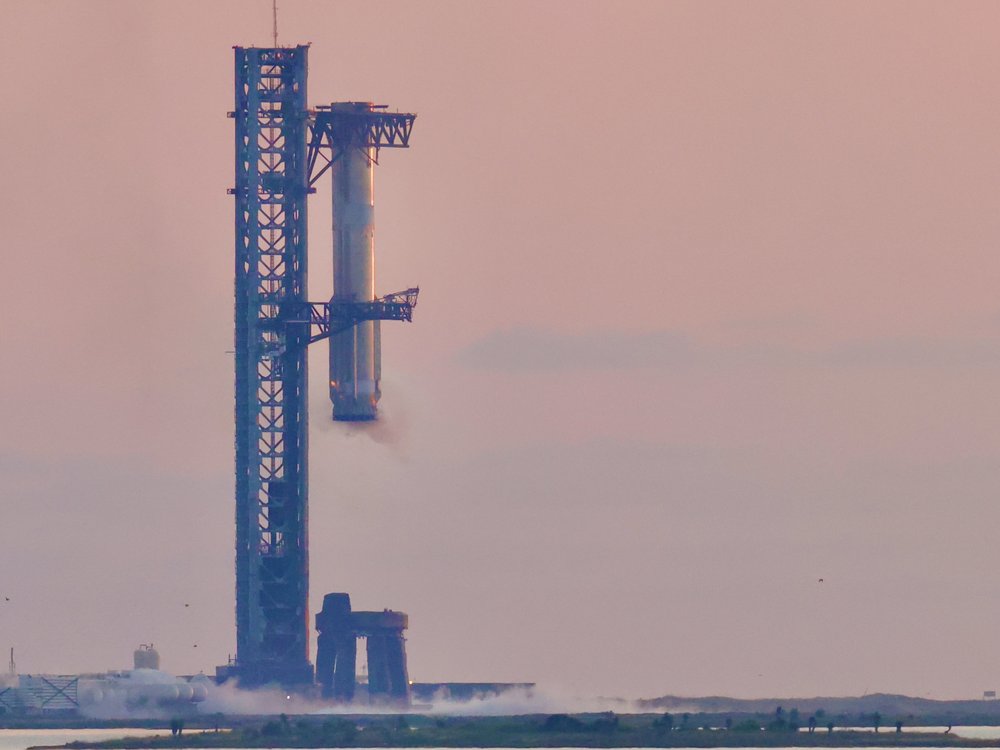
The first Starship catch has handed SpaceX the piece of reusability it was missing: an upper stage that comes back from orbit in one piece and lands where it can be flown again. On Saturday, Nov. 14, the Ship 42 upper stage returned to Starbase, Texas, and was caught by the launch tower's mechanical arms at about 4:20 p.m. EST, roughly 22.5 hours after Flight 15 lifted off and after 14 orbits of Earth. SpaceX had caught its Super Heavy booster on three earlier flights, but never the Ship, which flies higher and faster and has to survive reentry from orbital speed. The flight was not a clean sweep. The plan was a double catch, the first full recovery of an orbital rocket. Instead, the Super Heavy booster ended its boostback burn early on low fuel, triggered an automated abort, hovered over the Gulf of Mexico and was destroyed by its flight termination system. SpaceX says the root cause is under investigation. Why does catching the upper stage matter? Reusability is mostly about the parts you no longer throw away. Falcon 9, which has launched more than 700 times since 2010, recovers its first stage, but its second stage, the part that actually reaches orbit, is dropped into the ocean after every flight. Each mission still needs a brand-new upper stage. Starship is designed so both stages come home. Catching the Ship on the tower, rather than on landing legs, keeps extra hardware off the vehicle and puts it back on the pad where it can be inspected and refurbished. In its Flight 15 summary, SpaceX described a single sea-level Raptor relighting for the deorbit burn, followed by a three-engine landing flip and a slow descent between the arms. Several firsts made this possible. Flight 15 was only the second Starship to reach orbit, after Flight 14 on Sept. 28. It was also the first time a Ship reentered over inhabited areas, crossing parts of northern Mexico and southern Texas on its way back, a step the U.S. Federal Aviation Administration had to approve. Some of the Starlink satellites it deployed took images of the heat shield in orbit before controllers cleared the return. How far is SpaceX from airplane-like cadence? Far, on current numbers. Starship flew four times in 2024, five times in 2025 and four times so far in 2026. Starbase is authorized for 25 launches a year. Starship flew four times in 2026 before the first Ship catch; SpaceX is aiming for weekly flights in 2027. Elon Musk said on SpaceX's third-quarter earnings call in October that he expects Starship to fly weekly at some point in the first half of 2027 and twice a week or more by the end of that year. In a filing with the FAA, SpaceX said it expects to conduct 10,000 launches a year by 2030. A new site, Starbase, Louisiana, is meant to handle thousands of flights a year, but its first launch is not targeted until 2029. The catch is a necessary step toward those targets, not proof of them. President Gwynne Shotwell said SpaceX would try to refly a Ship early next year. Only then will the company learn how much work a returned heat shield and engines need between flights, which is the number that will ultimately decide cost per launch. What does Starship mean for Starlink? Starlink is where the payoff shows up first. Each Starlink V3 satellite adds about 1 terabit per second of capacity and is too large to fly efficiently on Falcon 9. The 26 V3 satellites released on Flight 15 match roughly 10 Falcon 9 Starlink launches in added downlink capacity, according to SpaceX. Flights 14 and 15 have now deployed 52 of them, and SpaceX says one Starship can carry up to 60. That matters because Starlink is the business funding the rocket. In the quarter ended Sept. 30, SpaceX's Connectivity segment, mainly Starlink, earned $2.37 billion of operating income on $5.25 billion of revenue, with 13.6 million consumer subscribers. The Space segment, which includes Falcon, Dragon and Starship, took in $1.77 billion but posted a small operating loss as its research and development spending reached $1.23 billion. Starlink profits fund Starship development while the Space segment hovers near break-even. SpaceX says 2027 Starship flights will focus largely on its own payloads, including more Starlink V3 satellites and direct-to-cell satellites. Every reused Ship lowers the cost of putting that capacity in orbit, which could widen the gap between Starlink and rival broadband constellations. What does it mean for NASA's Artemis program? A Moon-bound Starship has to be refueled in low Earth orbit by a series of tanker flights, and that only works economically if the tankers are reused quickly. Catching the Ship makes that architecture more realistic, but the hardest test is still ahead. SpaceX has said it aims to complete its long-delayed ship-to-ship propellant transfer demonstration early in 2027, and a NASA schedule presented in October placed it in the same window. NASA's Artemis III mission, targeted for the third quarter of 2027, will test docking between Orion and lander hardware in Earth orbit, while an uncrewed Starship lunar landing is planned before the end of 2027. NASA has not yet decided whether Starship or Blue Origin's Blue Moon will carry the first Artemis crew to the surface, on Artemis IV in early 2028. Where does this leave competitors? No other rocket flying today recovers its orbital upper stage. Blue Origin landed and reflew a New Glenn booster in April, but New Glenn has been grounded since a pad explosion in May and is not expected to fly again until January 2027. That leaves SpaceX alone in testing full reuse, while rivals still work on making their first stages reliable and frequent. The risk for SpaceX is execution, not physics. The booster that failed on Friday was a new Version 3 design, and a fully reusable system only pays off if both stages return routinely. The next few flights will show whether Saturday's catch can become a habit. Quick facts Flight 15 launch: Nov. 13, 2026, from Pad 2 at Starbase, Texas Ship catch: Nov. 14, about 4:20 p.m. EST, roughly 22.5 hours after liftoff and 14 orbits Booster: Super Heavy aborted its catch on low fuel and was destroyed over the Gulf of Mexico; cause under investigation Payload: 26 Starlink V3 satellites, about 10 Falcon 9 Starlink launches' worth of downlink capacity Cadence: 4 Starship flights in 2026 so far; Musk targets weekly flights in the first half of 2027 Next steps: Ship reflight and ship-to-ship propellant transfer, both targeted for early 2027 Sources: SpaceX flight summary and third-quarter 2026 results, NASA, Reuters, CNBC, BBC, Space.com and Ars Technica. Cover photo: Super Heavy booster held by the Starbase tower arms after an earlier catch, Steve Jurvetson, CC BY 2.0.