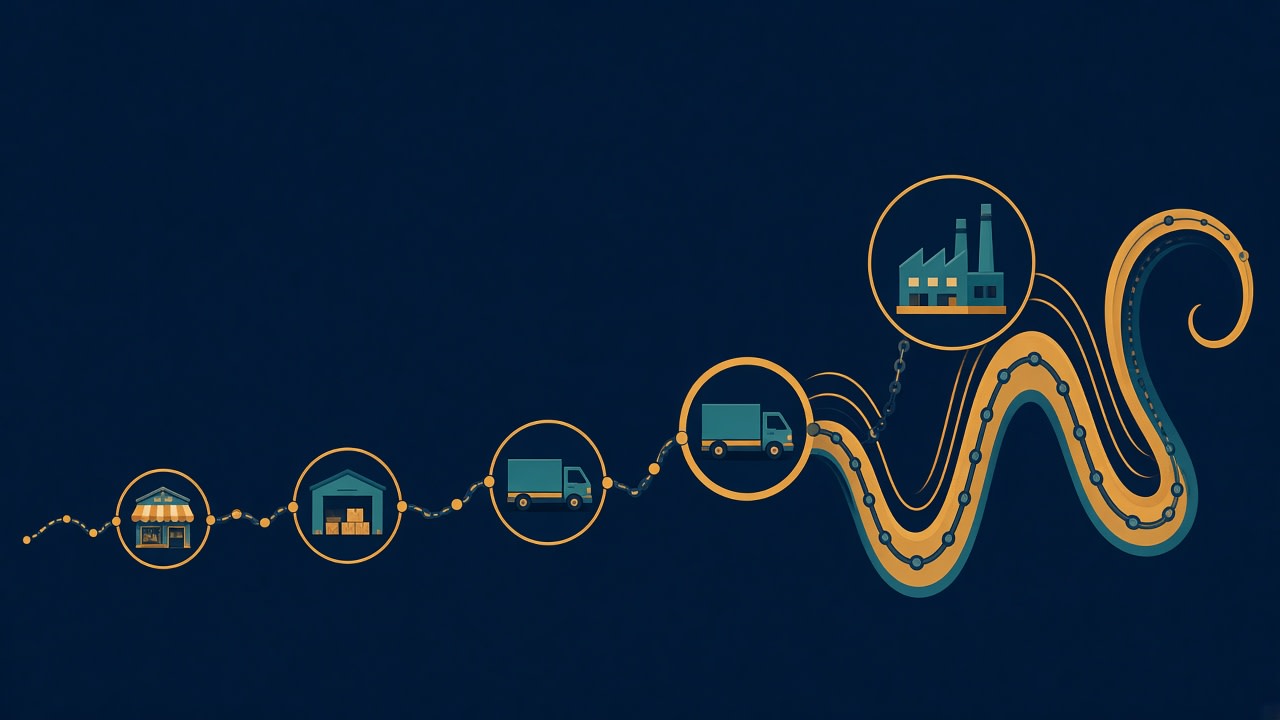
A small wobble in demand can become a storm upstream. The fix isn't more inventory. It's better information. Every few years, the supply chain world rediscovers an old lesson the hard way. A product suddenly sells out, retailers rush to reorder, distributors double their orders to be safe, and factories ramp up production. A few months later, the same companies are drowning in stock nobody wants. Then the discounts start. This pattern has a name: the bullwhip effect. A gentle flick of the wrist at the handle becomes a violent crack at the tip. In a supply chain, a small change in what customers buy turns into much larger swings in orders the further you move from the shelf. Why it happens The bullwhip isn't caused by bad people or bad luck. It comes from sensible decisions made with partial information. 1. Forecasting from orders, not demand. Most suppliers never see the end customer. They see orders from the next company down the chain. When a retailer orders more, the supplier reads it as rising demand, adds a little safety margin, and passes an even bigger order upstream. Each step adds its own guess on top of the last one. 2. Batching. Ordering costs money, so companies order in big, infrequent batches. Smooth daily demand turns into lumpy weekly or monthly spikes, and the supplier has to plan for the spikes. 3. Price swings and promotions. A discount pulls future demand into this week. Buyers stock up, then stop ordering for a while. Upstream, it looks like a boom followed by a bust that never existed at the checkout. 4. Shortage gaming. When supply is tight and allocation is rationed, buyers order more than they need, hoping to get a fair share. When the shortage ends, those phantom orders vanish overnight. 5. Long lead times. The longer it takes for an order to arrive, the more safety stock everyone wants, and the more every forecast error gets amplified. Why more inventory isn't the answer The instinctive response to volatility is a bigger buffer. But inventory is an expensive way to buy peace of mind. It ties up cash, takes up space, goes obsolete, and hides the real problem. A warehouse full of stock doesn't tell you what customers want next month. It just tells you what you guessed last quarter. Worse, buffers at every stage make the bullwhip stronger, because every player is reacting to the others' overcorrections. What calm supply chains do differently Share real demand, not just orders. When retailers share point-of-sale data and inventory levels with suppliers, everyone plans from the same signal. Collaborative planning, forecasting and replenishment (CPFR) and vendor-managed inventory are older ideas, but they work because they replace guessing with seeing. Shrink the batch. Smaller, more frequent orders smooth out the spikes. Shared trucks, consolidated shipments and automated reordering make small batches economical. Stabilize pricing. Everyday low pricing and fewer deep promotions keep demand closer to its true shape. Fewer artificial peaks mean fewer artificial troughs. Allocate on history, not on orders. During shortages, allocating supply based on past sales instead of current orders removes the incentive to inflate orders. Cut lead times wherever possible. Nearshoring some capacity, holding inventory closer to the customer, and speeding up information flow (not just goods) all reduce the distance a forecast error has to travel. Measure the whip. Compare how volatile your orders are with how volatile actual end-customer demand is. If your orders swing much more than demand, you're amplifying noise. That ratio is one of the most honest numbers a supply chain team can track. The real lesson The bullwhip effect is a reminder that supply chains are not chains of companies. They are chains of decisions. Each decision is reasonable on its own, and together they can create chaos. The companies that stay calm when others panic aren't the ones with the biggest warehouses. They're the ones that see real demand earliest, share what they see, and resist the urge to overreact. In supply chain, information moves faster than trucks. Let it. What's the biggest source of the bullwhip in your industry: promotions, lead times, or lack of visibility? I'd love to hear your take.