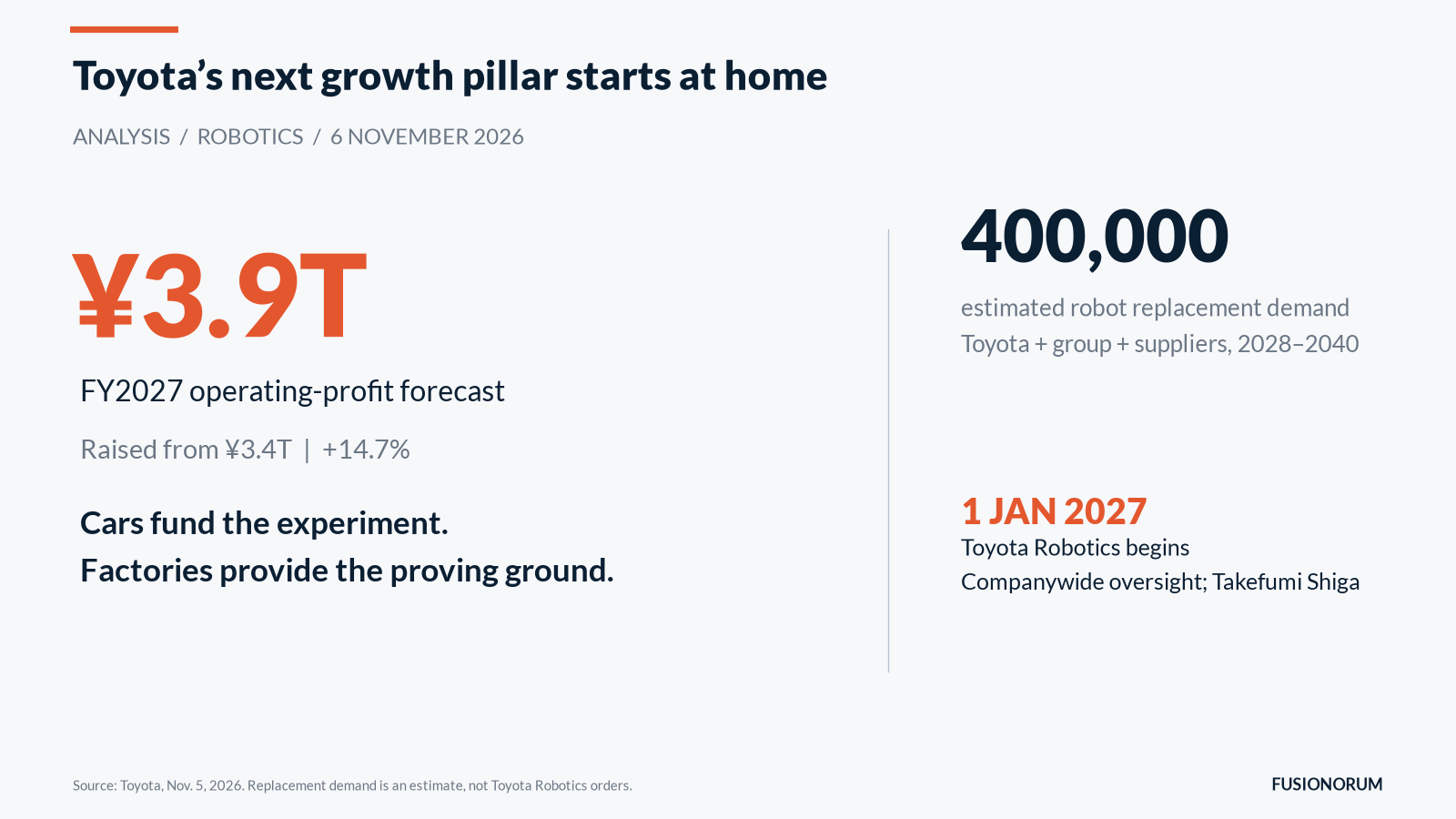
Toyota’s most credible pitch for a robotics business is not a machine that can do everything. It is a factory that already knows what needs doing—and an automotive business profitable enough to pay for the experiments. The Japanese manufacturer on November 5 raised its operating-profit forecast for the year ending March 2027 to ¥3.9 trillion, from ¥3.4 trillion. Alongside the earnings release, it announced a companywide Toyota Robotics organization, effective January 1, 2027, under chief production officer Takefumi Shiga. Toyota explicitly called robotics a key pillar of its future business. The announcements belong together, but not because robots explain the earnings recovery. They do not. Hybrids, regional improvements and lower tariff-related costs underpin the near-term financial story. Robotics is a longer-duration attempt to turn the capabilities behind that automotive business into another product. The investment question is whether Toyota can sell its manufacturing intelligence, rather than merely use it. A stronger engine for a longer bet Operating income for July–September reached ¥1.1276 trillion, up 34.3% from ¥839.5 billion a year earlier. That is the third calendar quarter of 2026, but Toyota’s second fiscal quarter—not its fiscal third quarter. The operating margin rose to 8.4% from 6.8%. The full-year forecast increase is ¥500 billion, or 14.7%. At Toyota’s revised assumption of ¥157 to the dollar, ¥3.9 trillion translates to approximately $24.8 billion. That conversion is an exchange-rate assumption, not another source of earnings growth. There is a useful complication: Toyota reduced its revenue forecast to ¥53.5 trillion from ¥54 trillion while raising expected operating income. Its forecast operating margin consequently moves to 7.3% from 6.3%. The upgrade is more about the economics of what Toyota sells and how it operates than a simple surge in volume. Hybrid demand is central. Toyota and Lexus sold 1.212 million conventional hybrids in July–September, up 10% year over year, even as their overall retail vehicle sales fell 4.4% to 2.507 million. North America also improved: first-half regional operating income, excluding interest-rate-swap valuation effects, recovered by ¥266.1 billion to ¥132 billion. Toyota cited lower tariff-related costs and accumulated improvement efforts in its higher annual outlook, while recovery work and optimized global supply helped mitigate materials inflation and production disruptions. The recovery is not universal. Toyota’s presentation shows first-half Toyota and Lexus retail sales in China falling to 685,000 from 914,000. Nor is operating profit the whole earnings picture: July–September net income attributable to Toyota fell to ¥759.4 billion from ¥932 billion. The robotics announcement should not become a reason to ignore those distinctions. Toyota raised FY2027 operating-profit guidance by 14.7%, after July–September operating income grew 34.3% year over year. The customer is already inside the system Toyota’s proposed route to commercialization begins with internal factory automation, including demand from Toyota Motor, group companies and suppliers. Only then does it extend toward other manufacturers, other industries and everyday-life applications. That sequence is strategically important. A robotics startup must often establish both that its technology works and that someone needs it. Toyota can begin with identifiable production tasks, existing facilities and operators able to judge whether a robot actually improves the process. Its internal network can supply test environments, operational feedback and initial deployment opportunities. The scale is substantial, but needs precise labeling. Toyota estimates cumulative replacement demand of 400,000 robots over 2028–2040: 150,000 at Toyota Motor and group companies, plus 250,000 at suppliers. The total includes both internally produced and purchased units. It is not an order book for Toyota Robotics, an annual shipment target or a forecast of external sales. The presentation also identifies ¥1 trillion a year of investment in reforms of aging facilities. That is a facility-renewal spending context, not a disclosed annual robotics budget. Treating either number as guaranteed robotics revenue would turn a potentially attractive entry market into an exaggerated valuation argument. Toyota estimates 400,000 robot replacements across its own operations, group companies and suppliers during 2028–2040; this is not a Toyota Robotics order book. Beyond another robot arm Toyota’s factory-automation framework has three parts. FA 1.0 is automation centered on rule-based robots. FA 2.0 synchronizes and automates production and logistics systems. FA 3.0 emphasizes human–robot collaboration. The company presents them as capabilities to combine, rather than a timetable in which every older machine must be replaced. The commercial opportunity may therefore lie as much in integration as in hardware. A robot arm can execute a task; a useful factory system must also coordinate material flows, avoid bottlenecks and adapt to variation without degrading quality. Toyota’s production-system expertise gives it a plausible foundation for addressing that broader problem. Toyota points to high-quality data from 60 plants and 18,000 craftspeople worldwide, alongside plans to apply knowledge from its Arene automotive software platform to robotics. Those are resources, not proof of a defensible software business. Nevertheless, they suggest a practical learning loop: capture skilled work, train systems against real tasks, deploy them under factory constraints and improve from observed results. Putting Shiga in charge reinforces that operational emphasis. Centralizing dispersed robotics personnel and functions under corporate oversight could reduce duplicated work and bring research closer to purchasing and deployment decisions. The organizational change signals an execution mandate; it does not establish commercial success. The hard part is selling beyond Toyota An internal deployment can generate value through lower costs, better throughput or more consistent quality without producing a single external sale. That is a sensible first outcome. It is also different from building a new revenue pillar. To cross that gap, Toyota will need solutions that work for customers without Toyota’s exact equipment, workflows or production discipline. Extensive customization could turn an apparently scalable robotics platform into a labor-intensive engineering service. Reliability, maintenance, training and systems integration will all affect customer payback and Toyota’s eventual margins. There is also a measurement problem. Facility upgrades, process redesign and robots may arrive together. Investors will need evidence showing how much improvement comes from the robotics offering itself, rather than from broader plant renewal. Useful milestones would include deployment counts, uptime, installation time, customer payback and repeat orders from independent buyers. These are analytical tests, not metrics Toyota has promised to disclose. The distinction matters for capital allocation. Automotive earnings can finance patient development, but they can also conceal a project’s weak standalone economics. A strong internal customer is an advantage only if commercial discipline survives the protection that customer provides. Toyota has a credible starting position: an earnings-generating core business, a large replacement-demand pool and direct access to manufacturing problems. Its November announcements make robotics more than a scattered research ambition. They do not yet make it a second earnings engine. The first proof will be productive machines inside Toyota’s network; the decisive proof will be customers outside it choosing to pay. Sources: Toyota’s November 5, 2026 FY2027 second-quarter IR presentation, financial-results release and organizational announcement.