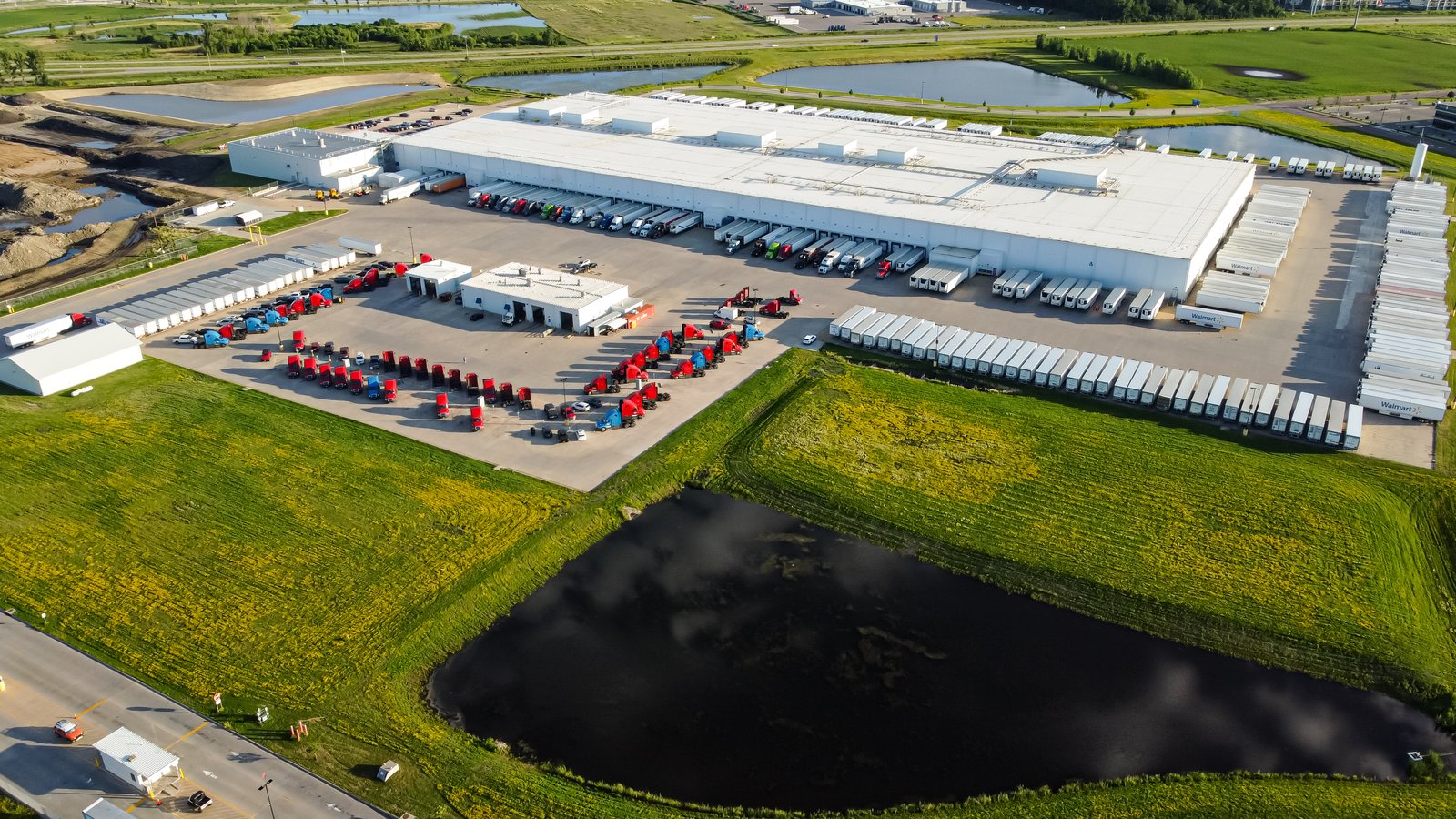
Walmart is committing about $6 billion to warehouse automation, expanding its long-running deal with robotics supplier Symbotic to add automated systems at 25 regional distribution centers in the U.S. The agreement, announced Oct. 29, covers work over several years. The deal matters because it shows the world's largest retailer doubling down on robots at a moment when moving goods is getting sharply more expensive. U.S. shippers spent 32.1% more on freight in the third quarter than a year earlier while volumes rose just 0.5%, according to the U.S. Bank Freight Payment Index. For Symbotic, the commitment cements a customer that already dominates its business, and adds a fresh layer of concentration risk. What is in the Walmart Symbotic deal? According to Symbotic's filing with the U.S. Securities and Exchange Commission, Walmart signed a new framework called an Enterprise Master Automation Agreement. Under it, Walmart committed to buy Symbotic systems and fund development programs worth an initial $6 billion in aggregate spending. That total includes $125 million for research into next-generation racking technology, plus related picking, process-flow and inventory-management capabilities. The systems are aimed at ambient, or non-refrigerated, areas of distribution and fulfillment centers in the U.S. and select international markets in the Americas. Symbotic said the commitment could add up to $6.92 billion to its future backlog. The commitment cannot be reduced without both companies' consent, and the contract sets out a payment calculation if Walmart buys fewer systems than promised. "Our work with Symbotic over the years, including this expanded agreement, helps us improve service, grow capacity, simplify work for our associates and lower costs," Rob Montgomery, executive vice president for Walmart U.S. supply chain operations, said in the joint announcement. How does warehouse automation cut supply chain costs? Symbotic's systems use fleets of robots, high-density racking and AI software to store and retrieve cases. Its product line now includes a BreakPack system that picks individual items and a SymMicro micro-fulfillment system for e-commerce orders. Walmart said the expansion targets upstream inventory management for e-commerce, greater storage capacity and more reliable replenishment of stores. Denser storage lets a single building hold more products, while automated handling reduces the labor needed per case. Both matter more when diesel tops $6.50 a gallon, as the freight index reported. "Shippers are spending substantially more to move essentially the same amount of freight," Bob Costello, chief economist at the American Trucking Associations, said in the U.S. Bank report. The squeeze comes as retailers weigh heavy capital spending, a theme Tabbicus explored in its look at Amazon earnings. High-bay warehouses like this one in Germany pack storage vertically to fit more goods on one site. Why does Symbotic depend so much on Walmart? Walmart accounted for 90.5% of Symbotic's revenue in the quarter ended June 27, up from 83.8% a year earlier, according to its latest quarterly report. Symbotic had about $22.5 billion of backlog at that date, the vast majority tied to Walmart and Exol, its warehouse-as-a-service joint venture. Symbotic reported quarterly revenue of $721 million, up 22%, and net income of $55 million. It guided for fiscal fourth-quarter revenue of $760 million to $780 million. Free cash flow, however, was negative $164.6 million in that quarter, showing how uneven cash collection on large projects can be. The contract also tightens governance ties. Walmart may recommend one independent board nominee while it owns more than 5% of Symbotic, and the deal restricts Symbotic from selling to one unnamed company. Investors welcomed the news cautiously. Symbotic shares rose 2.8% to $38.45 in premarket trading Friday, Reuters reported, after falling 37% this year through Thursday's close. Of 19 analysts covering the stock, 11 rate it a buy, five a hold and three a sell, with a median price target of $62.50, according to LSEG data cited by Reuters. What does the deal signal for European warehouse automation? Demand for automation is broad. North American companies ordered 10,989 industrial robots in the third quarter, up 24.8% from a year earlier, according to the Association for Advancing Automation, with orders from chip and electronics makers nearly doubling. In Europe, Norway's AutoStore, a maker of cube-storage systems, posted record second-quarter revenue of $192.1 million, up 43%, and order intake of $217.6 million. It has guided for full-year 2026 revenue of around $700 million. The Walmart contract shows how a single anchor customer can reshape a supplier's order book, a lesson that goes back to the earliest days of the history of supply chain management. The next test comes when Symbotic reports results for its fiscal year ended in September. Investors will look for how much of the $6.92 billion lands in backlog and whether new customers can dilute Walmart's share. Quick facts Commitment: About $6 billion over several years, including $125 million for research and development. Scope: Automation at 25 U.S. regional distribution centers, plus select markets in the Americas. Backlog impact: Up to $6.92 billion added to Symbotic's backlog of about $22.5 billion. Customer concentration: Walmart made up 90.5% of Symbotic's revenue in its latest quarter. Sources: company announcements and filings, industry data and Reuters reporting.